Love you later!


 But you can't go to a winery without tasting, even if you know what you want to buy. So we tasted. Or, rather, I tasted, he sniffed. They were pouring four different wines last weekend -
 3. 2005 Petite Sirah Central Coast - Sunset Magazine named this a "food friendly wine", and I can see that. It's a very mild wine that will not overpower most anything you could throw at it, and has a sweet red-fruit flavor that most people will like. I personally prefer a Merlot for that - it's just got a bit more body to it than the Petite Sirah.
I had a good time tasting, but picked only the Bien Nacido from the tasting to forward on to the BIL. He also received some Pinot Noirs from the Russian River and the Sonoma Coast. To your health!

 After the Japanese portion of the Garden, we went to the recently installed Chinese Garden, also known as the "Garden of Flowing Fragrance". As this garden has only recently begun, the bones of the garden are found in the architecture, as opposed to the plantings. Therefore, not much fragrance flowing just yet. From the Japanese Garden, you enter the Chinese Garden into a walled courtyard, with chrysanthemum imagery in the windows and lotus on the end caps of the roof tiles.
 The centerpiece of the garden is the "Lake of Reflected
  Fragrance", not quite balanced as of our visit. But there are vistas from every vantage point. The lake is actually located on a piece of land which naturally collects water during the rain, however, we haven't had rain for quite some time. The limestone rocks surrounding the lake are supposed to represent the craggy mountains in Chinese paintings.
 Clouds" was a joy. The "Wall of Water & Clouds" was topped with more of the roofing tiles from the entry wall, waving across the top in an echo of either a wave or the far mountain peaks. Each of the windows to the far side had a different pattern of fretwork installed and the zig-zag path lead us to the next place of beauty.

 gardens, let alone any of the art or library exhibits. I hear tale that the Children's Garden is awesome and the Conservatory has quite a collection of the odd and unique plants.
 After marveling at the beautiful blooms in the Huntington Rose Garden, we passed the pair of Lion-Dogs guarding the entrance to the Huntington Japanese Garden. Where the Rose Garden was a riot of color and exuberant blooms, the Japanese Garden is a 9 acre canyon of green calm. The Japanese Garden was begun in 1911, and the mature plantings reflect the age. As you descend under the wisteria arbor, your first view is of the Japanese house on the far side of the gully.Closer in the foreground is a Japanese half-moon bridge, over a koi pond. Too bad for us, the koi pond an
 d stream were undergoing renovation. However, the image of peace is persistent, despite the missing water. Traversing the gully to reach the Japanese house, you take time to notice the details like the Buddhas bordering the stream bed, or the lion head adorning the ridge-line of the bell house.
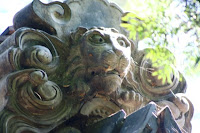
 Once past the bridge and back up the hill, the 19th-cen
 tury Japanese house offers a small vignette to reinforce the feeling of calm. Although not a tea house, it does have the set-up for a ceremony. It is filled with shoji, alcoves for display, and straw floor mats. Again, the details are what make the place special. The end-caps of the support beams are carved with floral scrolls and a lotus blossom perched atop what looks like a koi tail hugs the roof line.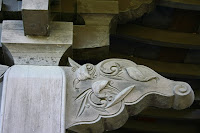

 The Zen garden opens to a courtyard filled with Bonsai. There, various members of the local societies had either donated or were caring for a large number of bonsai trees. This juniper (could be a cypress, I'm not sure) is one of my favorites. They also had bonsai pomegranate and grape vines, complete with fruit.
 ils that I'd like to remember for when I get the urge to finally do something about my yard. I love the half-moon bridge and willow, but I like the zigzag path/bridge through the bamboo more. The rock wall that held back the hillside from the stone stream consisted of a variety of black granite slabs, some were smooth polish, some were rough cut, and some looked like leftovers. It was interesting in that it had texture, but it was calming in that it was of a consistent material.
 lilies. Although very green in the heat of the summer, I cannot begin to imagine what it would look like in the spring. I really think this would be awesome on my uphill yard. Assuming of course, that I could convince the deer not to eat it, and the moles not pillage it.

 collection of gardens, and we managed to see quite a bit of the Rose Garden, the Japanese Garden and the Chinese Garden. And that's just too much for one post, so today we'll look at the Rose Garden.
 The Temple of Love begins your tour of the Rose Beds, a nice classical statue of a goddess and cupid in a small circular temple. The Temple is circled twice, the interior roses are the white roses above, "French Lace" and the exterior circle are the peach roses below, "Tamora". The Huntington website has a map
  of the rose beds, complete with rose names on it. Quite handy.


 Afterwards, we headed out to a yarn store - the Knitter's Studio (not pictured). I had found a place on Friday, but that store was full of discontinued, acrylic and novelty yarns, so I was sadly disappointed and will not review them. The Knitter's Studio, however, was just what I was looking for. They had cubbies wrapped around the perimeter of the store, nicely organized by color, style and maker. It was a joy to fondle the cashmere and silk yarns. I ended up with four skeins of Debbie Bliss Donegal Luxury Tweed in a beautiful aubergine color. I have to say aubergine instead of eggplant since Debbie Bliss is an English company. After feeding the parking meter three times (!) I managed to make my purchases so we could move on. If I lived in LA, they would be one of my favorite yarn stores. They were setting up for a beginning knitting class around the work table, complete with cupcakes & coffee.
 By this time we were starting to feel a bit of a hunger clench in our bellies, so we headed in the direction of the ocean and ended up on the Third Street Promenade in Santa Monica. I had suggested sushi since I don't get many takers in my family, and ended up at this interesting Balinese looking place called Monsoon. I ended up with a Rainbow Roll and a beef noodle bowl. I flustered the poor waiter by asking what he would have to eat for lunch. I wasn't picky about what to eat, just wanted something good. My friend had the Saikyo Yaki Black Cod, which is marinated in Miso Paste before it's cooked. My goodness, that was yummy. If I ever see it on another menu, I'll be having that for sure. The decor was pure Asian tongue-in-cheek, complete with brass dragon lanterns from the palm leaf ceiling and a stone "happy" fertility god in the ladies room. Fun!
 The architecture in Downtown Santa Monica is unique. They are trying to infuse the city with a sense of community, so all new & remodel work is going with three tiers. The bottom floor is retail space, the second floor office space, and the third floor housing. Evidently, it's being snapped up, because there is no where to turn without seeing some new construction. But, for the older buildings, you have to look up to see the more interesting parts. We were parked on an upper level of a garage, so I got to take pictures looking down on some

 had an hour or so left on the parking meter, so we hit the beach for a walk in the waves. We hiked up our pants, took our shoes off and headed up the coast line, with no destination in mind, just enjoying the last of the sun and the waves splashing. Just enough time to get a little bit of sun and exercise.
 Early Friday morning I joined the fuzzballs on the patio in the cool stillness of the LA dawn. It was quiet, something I've grown to need every day. My hostess has quite the collection of green things on her postage stamp patio, but there is a calmness in those things. The hummingbirds were chattering, waiting impatiently to be fed. And the cats were enjoying the fresh air, wondering if the birds would dare come close enough to swipe at. The apartments came alive around me. The garbage trucks were in the alley. A neighbor upstairs was obviously getting her kids ready for school, an Asian language floating down. Another neighbor was practicing singing scales, she still needs practice. A Slavic couple was banging dishes around eating breakfast, but by about 8:00 all was quiet again.
 Actually that was pretty good. And my view was not as bad as it seems. I had lucked out and parked near the Santa Monica Pi
 er, which is the home of an amusement park on the water. There was a "NO SWIMMING" zone due to the dangers of potentially getting thrashed against the piles. Fortunately, everyone else thought "NO SWIMMING" meant "NO SITTING" and I had about 20 yards of beach front property all to myself.
 The drive down to LA is about 400 miles, or 7-ish hours. I knew I was going to hit rush hour traffic, no matter what time I got there, so I planned for a stop in Santa Barbara to visit a historical landmark, the Santa Barbara Mission. There were 21 Catholic Missions established in California, and this is the first one I have visited - at least intentionally. I know very little about them, other than they exist, because frankly, I took Texas history, not California history in grade school. Although I should know more, this was a tourist stop for me, hopefully with the potential for some interesting photographs. Next time, I'll know more, thanks to wikipedia.
 e Franciscan Order established a line of Missions near the coast of California, both as a means to indoctrinate the local Indian tribes, but also to provide a safe route from the Los Angeles to San Francisco areas. This route is called "El Camino Real" which explains all the roads so named in the area. Hey, learn something new every day. The road way is marked with bells on a hook, a signpost that was developed in more recent history due to the lack of standard signage when the roadway was first established as a state highway.
 s of arches, tile roofs, carved railings, and also through the splendor of the intricate stone work in the cathedrals. However, instead or outfitting the mission with stone, the adobe plaster is painted to look like stone. Again, I don't know if this is modern or historical decoration. But, having been to some of the cathedrals in Europe, the details are similar. The columns seen in the picture are flat to the wall, painted to look like marble, as well as the cornice surrounding the doorway. The floral stone caps where arches meet in the ceiling of the cathedral - painted on the adobe. It feels primitive, like the Indians who may have painted it.
 e grounds, but I love the spareness of his form. All in all, it was a good stop. I think I may try and do a series of Mission stops and put together some kind of blurb book for my future tourist needs.


